#23Transformation modelPublished
Transformation.
Do you need to centralise change to control it?
In ten seconds
2026 publications on transformation models describe organisations where the capability to evolve is distributed, under tight steering.
The trigger
The drawing draws on 2026 publications by BCG and McKinsey on how to organise transformation.
The dominant reading
To control a transformation, you create a central structure that steers everything: a PMO, a transformation office.
The tension
The more decisions the central structure carries, the more it slows down the teams that have to change. It concentrates expertise the organisation should acquire.
The analysis
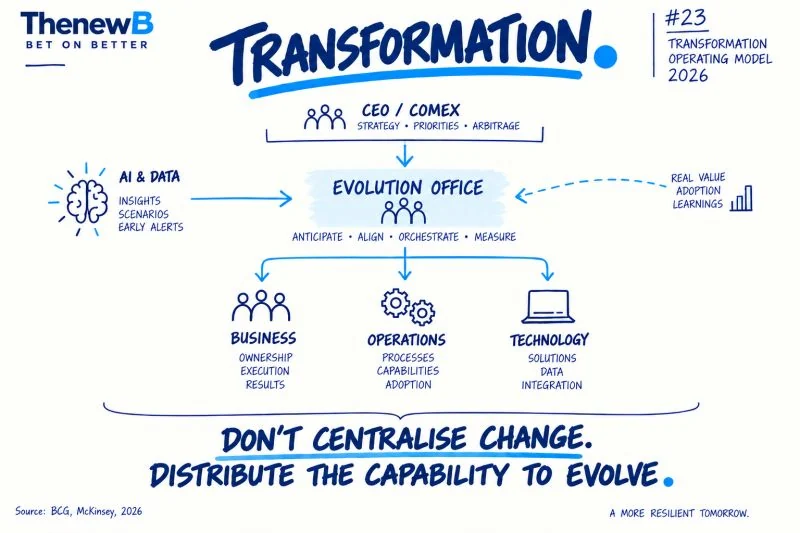
The drawing proposes an Evolution Office. It does not execute change. It anticipates, aligns, orchestrates and measures, using data and the signals surfaced by AI.
Business keeps responsibility for results, operations for processes and adoption, technology for solutions and data. In your organisation, who answers for adoption once the project is delivered?
What it changes
- The centre’s role moves from tracking progress to measuring real value.
- Business teams need change management skills.
- Lessons learned feed the executive committee’s decisions.
Action points
- 01Write down what the centre decides and what it delegates.
- 02Measure adoption and value after go-live, in addition to milestones.
- 03Plan the transfer of skills to the teams.
Sources
- BCG, McKinsey, 2026 (reference shown on the drawing)
Domains concerned
Ready to think differently?
Talk to us