#23Transformation modelPublished
Rethink.
Will your programme still be relevant on go-live day?
In ten seconds
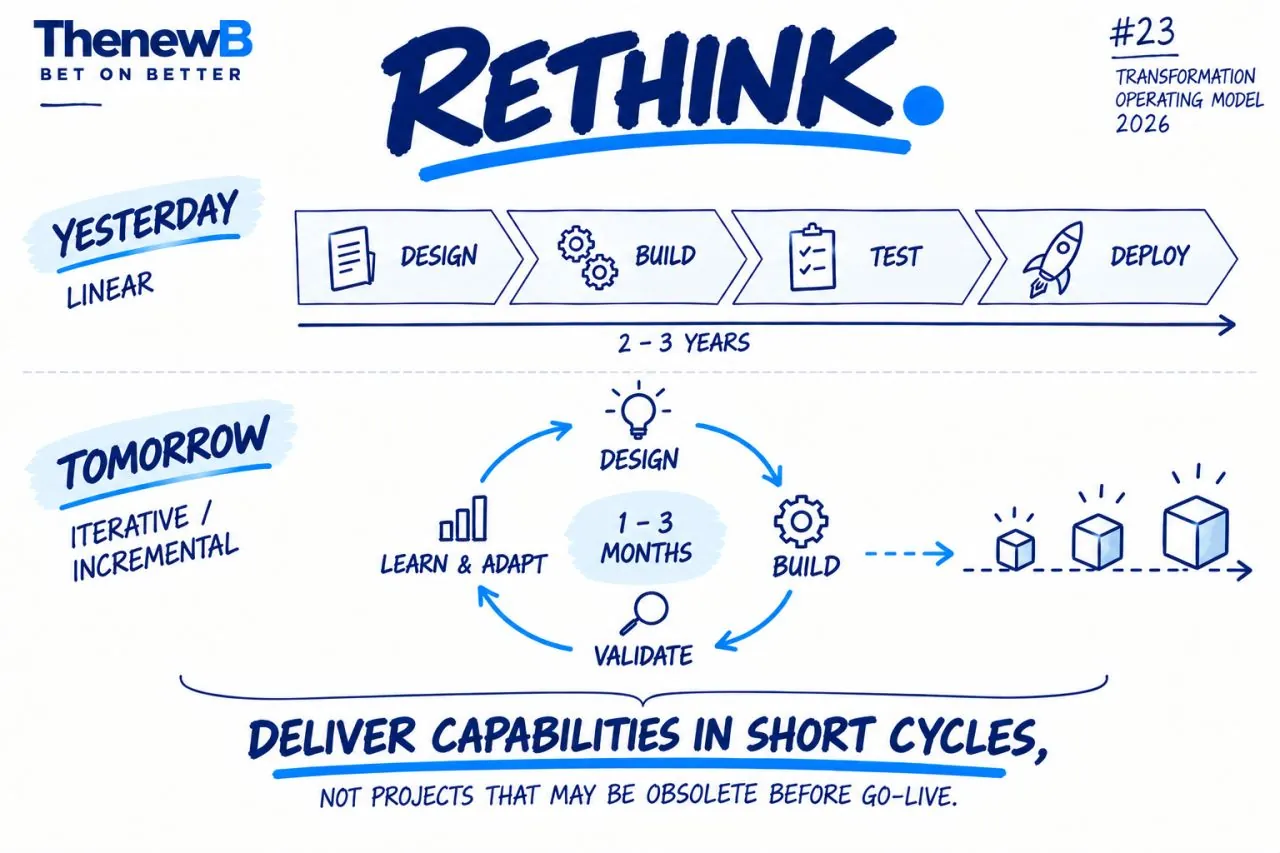
Yesterday, a linear two-to-three-year cycle: design, build, test, deploy. Tomorrow, cycles of one to three months.
The trigger
The drawing compares two ways of running a transformation: a linear two-to-three-year cycle, and iterative cycles of one to three months.
The dominant reading
A serious transformation needs a complete plan, approved upfront, then executed.
The tension
Over two or three years, regulation, technology and the market move. The plan does not.
The analysis
The short cycle does not remove rigour. It repeats it every one to three months: design, build, validate, then learn and adapt.
Each cycle delivers a usable capability. Decisions are based on what actually works.
What it changes
- Governance decides more often, on more concrete evidence.
- Contracts with integrators must provide for intermediate deliveries.
- Business teams are involved continuously.
Action points
- 01Break the programme into capabilities that can be delivered in under three months.
- 02Hold a decision committee at the end of each cycle.
- 03Measure the value obtained at each delivery.
Domains concerned
Ready to think differently?
Talk to us