#17AI and paymentsPublished
Mandate.
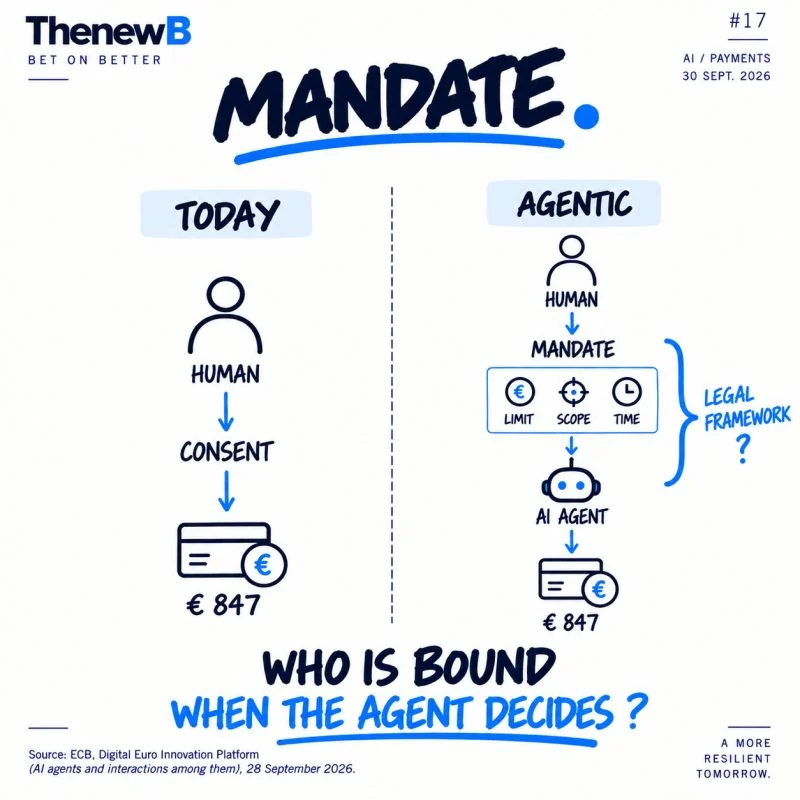
Who is bound when the agent decides?
In ten seconds
The ECB opens a new phase of its digital euro innovation platform, including workshops on AI agents and their interactions.
The trigger
On 28 September 2026, the ECB opened a new wave of its digital euro innovation platform. The exploration track plans 2027 workshops on AI-enabled payments, AI agents and their interactions, and micropayments. The ECB does not commit to including these uses in a future digital euro.
The dominant reading
The topic is presented as a payment innovation: an agent buys on your behalf, faster and at lower cost.
The tension
The amount is identical, €847 in the drawing. The nature of the commitment changes. Consent given for each payment becomes a mandate given once, executed by a machine.
The analysis
Today, strong customer authentication ties each payment to a human decision. With an agent, the decision is delegated within a frame: a limit, a scope, a duration.
Who answers for a purchase that fits the mandate but not the intention? Who proves what the customer had authorised? The drawing leaves the question open. So does the legal framework.
What it changes
- The mandate becomes something to design, trace and prove.
- Fraud and compliance controls must tell the agent apart from the customer.
- Customer trust rests on the mandate’s frame as much as on the interface.
Action points
- 01Define acceptable mandate parameters: limit, scope, duration, revocation.
- 02Keep usable evidence of the initial consent and of each execution.
- 03Follow the work of the ECB and national authorities before fixing a model.
Sources
- ECB, digital euro innovation platform, call of 28 September 2026
- Ledger Insights, September 2026
- crypto.news, September 2026
Domains concerned
Ready to think differently?
Talk to us